
KISSINGER = WAR CRIMINAL WITH A NOBEL PEACE PRIZE FOR MURDERING 150,000 CAMBODIANS WHILE SERVING NIXON + NOW WE SEE ANOTHER EVIL MURDER PLOT.
Kissinger Drew Up Plans to Attack Cuba, Records Show = AN ACT OF PERSONAL REVENGE USING AMERICAN MIDDLE CLASS MONEY.
Click for NYT Source Article on Kissinger Criminality
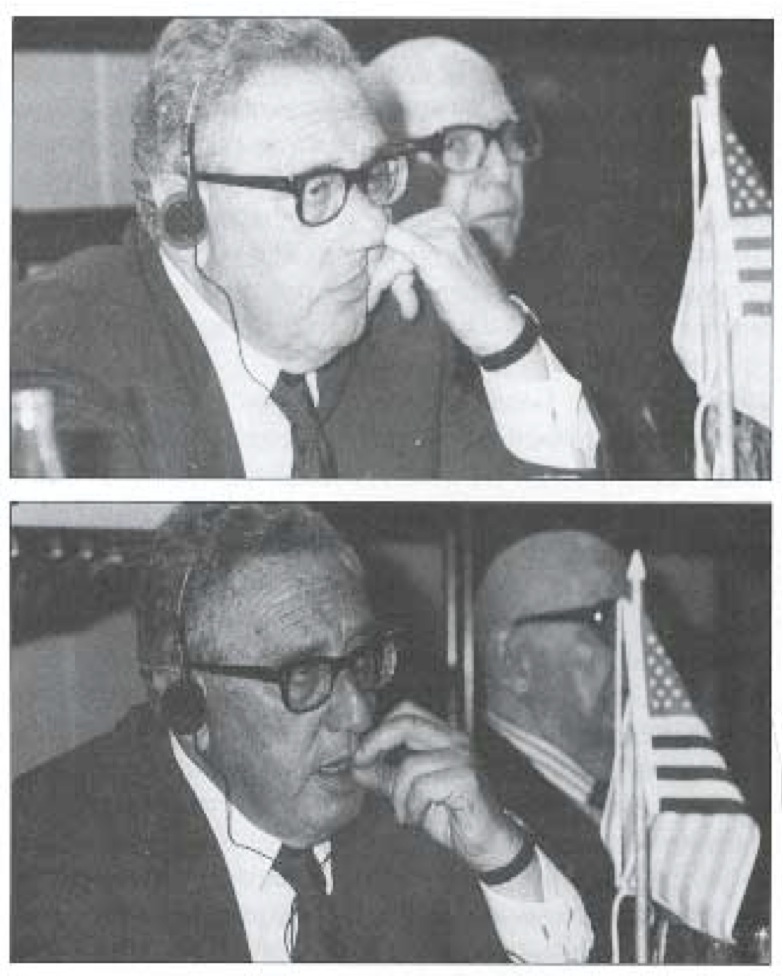
THE DIRT BAG MURDERER!
KISSINGER INDICTED by newly released USA Documents: Kissinger Drew Up Plans to Attack Cuba, Records Show = AN ACT OF PERSONAL REVENGE USING AMERICAN MIDDLE CLASS MONEY.
KISSINGER INDICTED by USA Documents published in “Back Channel to Cuba,” a new book written by the longtime Cuba experts William M. LeoGrande, a professor of government at American University, and Peter Kornbluh, the director of the archive’s Cuba Documentation Project.
Kissinger, NOBEL PRIZE WINNER WHO MURDERED 150,000 OR PERHAPS MORE CAMBODIANS THAN ANY DICTATOR, was secretary of state from 1973 to 1977.
“Nobody has known that at the very end of a really remarkable effort to normalize relations, Kissinger, the global chessboard player, was insulted that a small country would ruin his plans for Africa and was essentially prepared to bring the imperial force of the United States on Fidel Castro’s head….You can see in the conversation with Gerald Ford that he is extremely apoplectic…(adding Kissinger used) “language about doing harm to Cuba that is pretty quintessentially aggressive.”
— Peter Kornbluh
1976: Kissinger + Gerald R. Ford Nearly 40 years ago mapped out secret plans to launch airstrikes against Havana and “smash Cuba,” newly disclosed government documents show and documents declassified by the Gerald R. Ford Presidential Library at the request of the National Security Archive, a research group.
Kissinger’s prepared plan was to be implemented after the 1976 presidential election to attack Cuba, BUT went nowhere because Jimmy Carter won the election.
KISSINGER PLANNED to strike ports and military installations in Cuba and to send Marine battalions to the United States Navy base at Guantánamo Bay to “clobber” the Cubans, as Mr. Kissinger put it, according to the records. Mr. Kissinger, the documents show, worried that the United States would look weak if it did not stand up to a country of just eight million people.
KISSINGER: “I think sooner or later we are going to have to crack the Cubans.”
— Kissinger told President Ford in the Oval Office in 1976
BASED ON USA documents posted online and published in “Back Channel to Cuba,” a new book written by the longtime Cuba experts William M. LeoGrande, a professor of government at American University, and Peter Kornbluh, the director of the archive’s Cuba Documentation Project.
Kissinger, NOBEL PRIZE WINNER WHO MURDERED 150,000 OR PERHAPS MORE CAMBODIANS THAN ANY DICTATOR, was secretary of state from 1973 to 1977.
“Nobody has known that at the very end of a really remarkable effort to normalize relations, Kissinger, the global chessboard player, was insulted that a small country would ruin his plans for Africa and was essentially prepared to bring the imperial force of the United States on Fidel Castro’s head.” — Peter Kornbluh
“You can see in the conversation with Gerald Ford that he is extremely apoplectic…(adding Kissinger used) “language about doing harm to Cuba that is pretty quintessentially aggressive…These were not plans to put up on a shelf. Kissinger is so angry at Castro for sending troops to Angola at a moment when he was holding out his hand for normalization that he really wants to, as he said, ‘clobber the pipsqueak.’”
— Mr. LeoGrande
Kissinger called for scores of aircraft to mine Cuban ports and warned that USA risked losing its Navy base in Cuba was vulnerable to counterattack+ A military blockade of Cuba’s shores + Warned that most likely a conflict with the Soviet Union (top Cuba ally) at the time + Estimated 1976 cost was $120 million to reopen the Ramey Air Force Base in Puerto Rico and reposition destroyer squadrons.
“If we decide to use military power, it must succeed,” Mr. Kissinger said in one meeting, in which advisers warned against leaks. “There should be no halfway measures — we would get no award for using military power in moderation. If we decide on a blockade, it must be ruthless and rapid and efficient.”
Kissinger’s prepared plan was after the 1976 presidential election to attack Cuba went nowhere because Jimmy Carter won the election.
Mr. Kissinger, now 91, refused a request to comment.
Memos prove Rumsfeld was present at the meeting Kissinger ordered up the contingency plan — Refused a request to comment.
Some Cuba historians said the revelations were startling, because USA was just coming out of the Vietnam War. Frank O. Mora, former deputy assistant secretary of defense said. “For Kissinger to be talking the way they were talking, you would think Cuba had invaded the whole continent.”
John F. Kennedy’s offered an olive branch to Fidel Castro after the missile crisis, but Kissinger’s record of MALICE AND REVENGE in hundreds of formerly secret U.S. documents.Henry Kissinger had serious plans to bomb and ‘smash’ Cuba
Click for THE WEEK Source Article on Kissinger Criminality
It isn’t clear why the secretary of State was ordering up war plans.
— Peter Weber
National Security Archive Electronic Briefing Book No. 487 Posted October 1, 2014 — READ THE DOCUMENTS:
Document 1: Memorandum of Conversation, February 25, 1976
During a conversation with President Ford in the Oval Office, Secretary of State Kissinger raises the issue of Cuba’s military incursion into Angola, implying that Latin American nations are concerned about a “race war” because of Cuba’s efforts in Africa. “I think we are going to have to smash Castro. We probably can’t do it before the elections.” The president responds, “I agree.”
Document 2: Memorandum of Conversation, March 15, 1976
In another Oval Office conversation, Kissinger raises the Cuban military involvement in Africa and expresses concern that Castro may deploy troops elsewhere in the region. “I think sooner or later we have to crack the Cubans … I think we have to humiliate them.” He continues to argue that, “If they move into Namibia or Rhodesia, I would be in favor of clobbering them. That would create a furor … but I think we might have to demand they get out of Africa.” When President Ford asks, “what if they don’t?” Kissinger responds, “I think we could blockade.”
Document 3: Washington Special Actions Group Meeting, Cuba, March 24, 1976
Kissinger convenes The Washington Special Actions Group-a small elite team of national security officials-on March 24 to discuss a range of options and capabilities to move against Cuba. “We want to get planning started in the political, economic and military fields so that we can see what we can do if we want to move against Cuba,” he explains. “In the military field there is an invasion or blockade.” Kissinger shares his domino theory of Cuban military involvement in the region. “If the Cubans destroy Rhodesia then Namibia is next and then there is South Africa. It might only take five years,” Kissinger argues. In discussing military options, he states, “if we decide to use military power it must succeed. There should be no halfway measures – we get no reward for using military power in moderation.” Kissinger orders the group to secretly draw up plans for retaliation if Cuban troops go beyond Angola.
Document 4: Cuban Contingency Plan Summary, (ca. April 1976)
This document is a summary of the Cuban Contingency survey considering the possible U.S. reactions to continued Cuban and USSR “Angola style” intervention. The summary notes that the U.S. is already engaging in some efforts to dissuade further intervention through “public warnings, signals to the USSR, changes in our African policy and some measures designed to isolate Castro.” While any U.S. response will affect U.S.-Soviet relations, “It is easier to bring pressure on Cuba, as the closer and weaker partner in a tightly interwoven relationship, than on the Soviet Union.”
Document 5: Cuban Contingency Plan Paper 1, (ca. April 1976)
According to this lengthy contingency planning paper, the objective of these plans is to prevent a pattern in which Cuba and the USSR “arrogate to themselves the right to intervene with combat forces in local or regional conflicts.” The contingency plan outlines four courses of action that vary on a scale of seriousness for deterring continued Cuban intervention, including: political pressure, actions against the USSR, a scenario of actions (combining political, economic and military measures), and military steps. Any actions taken towards Cuba could spur greater tension with the USSR. “In short, confronting Cuba — the weaker partner — is an obvious step toward confronting the USSR.” Political measures are presented as the best option for dissuading Cuba because of the increased chances of a U.S.-Cuban “incident” stemming from military actions. Along with the possibility of an incident, this document notes that “one of Cuba’s main foreign policy objectives has been to normalize relations with the countries of this hemisphere.”
The document outlines the option for a quarantine. As Cuba is highly dependent on imports and foreign military equipment (from the USSR), especially by sea, the U.S. would be able to exacerbate Cuba’s greatest vulnerability. On that same theme, the paper points to the U.S. base at Guantanamo as the greatest vulnerability for a Cuban response to any U.S. military actions. Other military steps outlined in the plans include mining Cuban ports and conducting punitive strikes against selected targets.
Document 6: Cuban Contingency Plan Paper 2, (ca. April 1976)
This paper covers several categories of U.S. actions against Cuba: deterrence, pressure to cease and desist, interdiction of Cuban action under way, and retaliation. Any form of deterrence taken by the U.S. would have to be “predicated on a willingness to take some action if the deterrence failed.” However, and reiterated once again, any action taken to confront Cuba would also incite a confrontation with the USSR. The possible military measures presented include three forms of quarantine (selected war materiel, POL imports, maritime blockade excluding food and medicine), mining Cuban ports, and punitive airstrikes on selected targets.
The document notes two important ambiguities — the role of Cuban military involvement in Africa and the threshold to determine the U.S. response to a Cuban provocation. “In sum, there is a good chance the US will be confronted by an ambiguous situation, in which Cuban intervention is not clearly established.” As well, there is “no precise threshold” which would determine the U.S. response, except to state that the threshold would be low if Cuban action were directed against the US or its territories (Puerto Rico), higher in the Caribbean and Latin America, and highest in Africa.
The document states that “we should further make it clear that we are not reverting to the shenanigans of the early 1960’s” and that the U.S. is not violating any international agreements. While the Soviets in 1970 indicated that they regarded the 1962 U.S.-Soviet agreement as still in force, the “failure of the Cubans to permit the UN supervision renders the US pledge technically inoperative.”
Document 7: Kissinger Aide-Memoire to Cuba, January 11, 1975
This conciliatory message drafted by an aide to Kissinger, and approved by the Secretary of State, was given to the Cuban side at the first meeting between U.S. and Cuban representatives, which took place at a cafeteria in La Guardia airport. “We are meeting here to explore the possibilities for a more normal relationship between our two countries,” it begins. The objective is to “determine whether there exists an equal determination on both sides to settle the differences that exist between us.” While the ideological differences are wide, Kissinger expresses hope that such talks will “be useful in addressing concrete issues which it is in the interest of both countries to resolve.” As a gesture to the Cubans, the U.S. will permit Cuban diplomats (accredited to the UN) to travel from New York to Washington and may begin granting additional visas to Cubans for cultural, scientific and education meetings. For Kissinger, “no purpose is served in attempting to embargo ideas.”
Document 8: Memorandum for the Secretary, Meeting in New York with Cuban Representatives, January 11, 1975
In a briefing paper on the first secret meeting at La Guardia airport, Kissinger’s aide Lawrence Eagleburger reports on the tone and exchange of views. The Cubans stated they had no authority to negotiate at that time, but emphasized the importance of removing the embargo as a “sine qua non” for talks. Eagleburger reports that he wanted to “leave both Cubans with a clear understanding that while I had received their message, I was in no way prepared — even unofficially — to accept [removing the embargo] as a precondition to further talks.” Even though at times there was a seemingly difficult tone in the meeting, as Eagleburger explains, “the atmosphere of the meeting was extremely friendly.”
Document 9: Memorandum of Conversation, Pierre Hotel, U.S.-Cuba Meeting, July 9, 1975
This meeting marks the first formal negotiating session to explore normalized relations between the United States and Cuba. To break the ice, Eagleburger suggests that Kissinger is disposed to meet with the Cuban foreign minister during the upcoming UNGA meetings in September. Assistant Secretary of State William D. Rogers begins by explaining that Washington would support lifting multilateral sanctions at the OAS and that the United States would then begin to dismantle the trade embargo, piece by piece, in response to similar gestures from the Cubans. Over the course of the next three hours the U.S. and Cuban officials discuss a series of reciprocal and bilateral improvements of relations, with much of the meeting focused on the Cuban responses to the points raised by the U.S. side. Responding to the piece by piece approach of the U.S., the Cuban representatives reiterate that any precondition for talks remains the lifting of the embargo. “We cannot negotiate under the blockade,” Ramon Sánchez-Parodi argues; “until the embargo is lifted, Cuba and the United States cannot deal with each other as equals and consequently cannot negotiate.”
 Concise Politics -- Your Time should NOT be wasted.