
SNOWDEN AND ELSBERG AND WILLIAM WORTY = HEROS FOR AMERICANS
Click for Source: “The Most Important Journalist You’ve Never Heard Of”: Remembering William Worthy (1921-2014)
William Worthy, a brave and principled dissident American journalist = Defied the U.S. government by reporting from the Soviet Union, Cuba, China, Iran, North Vietnam and Algeria during the Cold War.
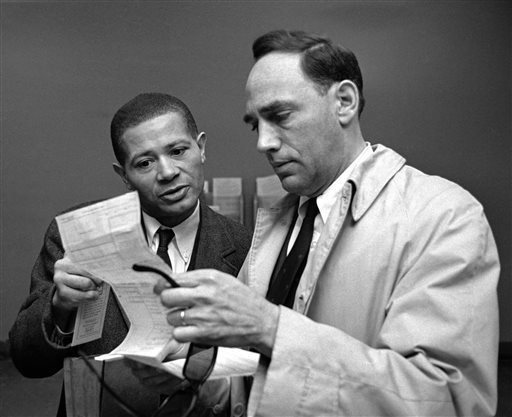
1964 William Worthy, 42, left, and attorney William Kunstler hold an application for new passport and the $10 it cost Worthy to file it at the U.S. passport office, in New York.
William Worthy, a foreign correspondent for The Afro-American of Baltimore, a weekly newspaper, from 1953 to 1980 (Cold War) went to the Soviet Union, China, Cuba and Iran. Mr. Worthy also contributed freelance reports to CBS News, The New York Post and other publications.
During his years at The Afro-American, he kept one foot in the realm of direct advocacy, joining Freedom Riders on their pilgrimages through the South and later becoming a close ally of Malcolm X.
Award-winning journalist Jeremy Scahill considered Worthy a mentor, said: “For this generation of younger journalists who are coming of age in the era of the Edward Snowden documents, WikiLeaks, of the government surveillance on the metadata of journalists and many millions of people in this country and around the world, I would say that William Worthy is the single most important journalist that they’ve never heard of. If Bill Worthy was a white journalist, and not been an African-American journalist, he would be much better known than he is right now.”
USSR: In 1955, he spent six weeks in Moscow, interviewing ordinary citizens and the future Soviet premier Nikita S. Khrushchev, who at the time was first secretary of the Soviet Communist Party.
CHINA: In the late 1950s, the State Department refused to renew his passport after he returned from a reporting trip into China. Defying a United States travel ban, he crossed into mainland China from Hong Kong. He was one of the first American journalists admitted there after the United States broke off relations after the 1949 Communist takeover. He visited Premier Zhou Enlai in Beijing in 1957. He spent 41 days traveling the country, interviewing people in schools, factories, hospitals, and Shanghai prison, where he interviewed American P.O.W.s captured during the Korean War. The United States knew the men were being held somewhere in China, but in several cases Mr. Worthy’s reports were the first to pinpoint their location.
After returning to US in 1957, Worthy tried to renew his passport, but Secretary of State John Foster Dulles refused because, “Mr. Worthy’s testimony (is) that should his passport be renewed he would not feel obligated, under present world conditions, to restrict his travel abroad in any way.”
Mr. Worthy was a Nieman Foundation fellow in the 1956-57 academic year = Nieman Foundation for Journalism at Harvard.
CUBA: Despite not having a passport, Worthy traveled to Cuba in 1961 — two years after the Cuban Revolution — and interviewed Fidel Castro. He was arrested and indicted upon returning to Florida — not for traveling to Cuba but for entering the United States illegally — an American citizen without a passport. In 1962 a judge in federal court in Miami found him guilty and sentenced him to three months’ imprisonment plus nine months’ probation. = Subject of Phil Ochs’ song, “The Ballad of William Worthy.” The case became a sensation with Rallies held in cities around the world. The British philosopher Bertrand Russell petitioned the United States attorney general, Robert F. Kennedy, in support of him.
1964 US Court of Appeals tossed out the silly ruling saying CITIZENS CAN DO BE BARRED FROM RE-ENTERING THE USA for NOT having a passport.
Mr. Worthy was not granted a new passport until 1968. Over the years, his other travels — with a passport or without — took him to North Vietnam, Indonesia, Cambodia and Algeria.
Worthy filed articles on interviews with Fidel Castro about the country under Communism, with particular attention to race relations, which he judged far better than those in the United States.
IRAN: In 1981, Worthy traveled to Iran, two years after the revolution ousted the U.S.-backed Shah, resulting in a series of blockbuster exposés about U.S. actions in Iran. He and colleagues examined the effects of the Islamic revolution there. Worthy most importantly bought a multivolume set of CIA intelligence documents taken from the United States Embassy in Tehran after revolutionary militants seized it in 1979. = Readily available in Iran and were already circulating in Europe, BUT the FBI deeming them classified, seized them on the journalists’ return to US. However, Worthy was able to furnish a duplicate set to The Washington Post who authenticated and published a series about US intelligence operations in Iran. US paid $16,000 to settle a suit by Mr. Worthy and his colleagues over the seizure. = Worthy said, “Americans have a right to know what’s going on in the world in their name.”
“..my sisters and I were clearly aware, as children, of our ‘inferior’ minority group status.”
— Mr. Worthy 1968 article for The Boston Globe.
Recently Declassified Documents Reveal CIA Role In 1953 Iranian Coup
CIA Overthrow of Former Iranian Premier Mohammed Mossadegh 1953 was a template for the agency’s covert operations going forward = declassified documents prove. Orchestrating the Iranian coup d’état was a first for the CIA and was used for 50+ Cold War covert operations worldwide.
Mossadegh felt “ruled by foreign empires” and after less than a week in office, on May 1, 1951, decided to nationalize the (BP OIL) British-run Anglo-Iranian Oil Company. = BRITISH HAD A FIT! = “But, to many Iranians, especially those who did not remember that there was no oil in Iran before the British came, it was just unfair for a British company to have a monopoly over Iranian oil.”
British decided “Mossadegh had to go in order for the British to keep their monopoly.” British began measures to topple the Iranian prime minister. In 2 years the CIA used used suitcases full of cash to destabilize the regime, spy craft, and subversion to do the overthrow. = “Mossadegh was a very strong politician and a very strong man.” = CIA bought newspaper editors + Hoodlums + Organized rallies in cities + “Created a fake communist party.” Mossadegh and his allies thwarted the first coup attempt Aug. 15, 1953. Four days later, a second coup attempt was successful. = “It’s kind of left a bitter taste in Iranians’ mouths. It’s created a very good excuse for the Iranian government to exploit the genuine grievances of the Iranian people.” — Bahari
In later years, Mr. Worthy taught journalism at Boston University; the University of Massachusetts, Boston; Howard University; and elsewhere. In 2008, he received the Nieman Foundation’s Louis Lyons Award for Conscience and Integrity in Journalism.
Mr. Worthy published a book, “The Rape of Our Neighborhoods,” (1976)
 Concise Politics -- Your Time should NOT be wasted.